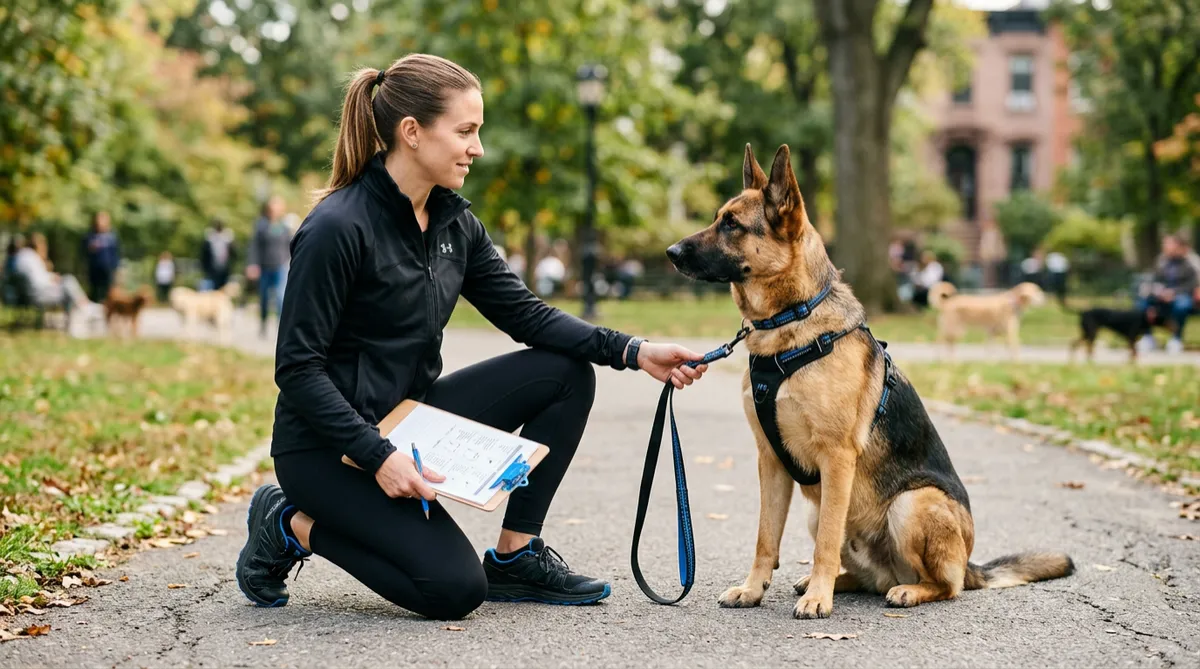
Disclaimer: This article is for general education only and isn't a substitute for an in-person evaluation. Every dog is different. If your dog shows aggression, extreme fear or any sudden behavior change, talk to a qualified trainer or your veterinarian before you try any new method or tool.

Let's be honest: most dogs don't struggle because they're stubborn. They struggle because nobody gave them a clear plan. If you've been winging it with treats on Monday and frustration by Friday, this guide is for you. Here's how to create a training plan using balanced dog training techniques, step by step, so you and your dog know exactly what you're working on and why. We're a Brooklyn dog training team, and this is the same simple framework we use with our own clients.
What Balanced Dog Training Techniques Actually Mean
Balanced dog training is a style that uses all four quadrants of operant conditioning, which is just the science of how dogs learn from the results of their actions. In plain English: you reward what you like, and you give fair, clear feedback about what you don't. The American Kennel Club has a helpful breakdown of the four quadrants of operant conditioning if you want the full science. The short version is that you either add or remove something, and the behavior becomes either more or less likely.
Here's the part people miss: balanced doesn't mean harsh. In a good balanced dog training program, rewards do the heavy lifting. Food, toys, play and praise teach your dog what to do. Corrections, like a calm leash pop, a quick "ah-ah," or simply turning away and ending the fun, are a small, well-timed part of the picture. Think of raising a kid: lots of "great job!" and a clear "not that one" when it matters.
Some trainers stick with rewards only, and that's a valid choice for plenty of dogs. Balanced trainers simply want every tool available, especially for tougher issues like leash pulling, reactivity or an unreliable recall.
Step 1: Set Clear Goals for Your Dog Training Plan
A plan without a goal is just a to-do list. Before you pick a single command, grab a notebook and answer three questions:
- What drives you nuts right now? Pulling on the leash, jumping on guests, ignoring "come"?
- What does your dog need to be safe? Recall and "leave it" always rank high, especially in a busy city.
- What does success look like? Make it measurable, like "walks one full block on a loose leash."
Pick two or three goals, not ten. Dogs learn best when you focus on a few skills at a time. Also factor in your dog's age, breed and energy level. A high-drive young Shepherd needs a very different plan than a senior Pug.
Step 2: Build Your Balanced Dog Training Toolbox
Next, figure out what motivates your dog, because a reward only counts if your dog actually wants it. Test a few options: soft treats, a favorite tug toy, a quick game of fetch. Save the jackpot rewards for harder jobs, like coming when called outside.
Then pick a marker word. Say "yes!" the instant your dog does the right thing, then deliver the reward. That tiny word is how you tell your dog, "That's exactly what I wanted." Timing matters here. Reward within a second or two, or you may end up rewarding something else entirely.
As for gear, start simple with a flat collar or harness, a six-foot leash, a long line for recall practice and a treat pouch. If you're thinking about more advanced tools, like a prong collar or a remote collar, bring in a professional first. These tools only work well with proper fitting, low intensity and good timing.

Step 3: Map Out a Weekly Dog Training Schedule
Here's some good news for busy people: you don't need hours. Consistency beats duration every time. The AKC points out that small training sessions can make a big impact, and that you can fold practice into meals, walks and everyday routines. Aim for five to ten minutes, a couple of times a day, and always end on a win.
Here's a simple four-week framework you can copy:
- Week 1, Foundations: Teach your marker word, name response, sit and a settle on a mat. Keep it in a quiet room with zero distractions.
- Week 2, Leash and recall basics: Practice loose-leash walking in your hallway or yard, and start recall on a long line. Reward heavily.
- Week 3, Add duration and light feedback: Ask for longer stays and more distance. Once your dog truly knows a cue, begin using small, fair corrections when they blow it off.
- Week 4, Real-world proofing: Take it outside to quiet streets, then busier sidewalks. Review all your goals and adjust.
Write the schedule on your fridge so everyone in the house follows it. If you'd rather have an expert build and coach it with you, take a look at our dog training programs.
Step 4: Teach New Skills With Rewards First
Always teach before you correct. A dog can't follow a rule they've never been shown. Use this simple loop for every new skill:
- Lure or guide: Use a treat to help your dog into position, like a sit.
- Mark and reward: Say "yes!" the moment they get it right, then feed.
- Add the cue: Only say "sit" once your dog is reliably doing it.
- Fade the lure: Use an empty hand, then reward from your pocket or pouch.
Keep each step easy enough for your dog to win. If they're struggling, don't push harder. Make it simpler, then rebuild.
Step 5: Add Fair, Clear Corrections to Your Balanced Dog Training
This is where balanced dog training techniques really differ from reward-only approaches, and where good timing matters most. Corrections should be the last layer, not the first. Use these ground rules:
- Only correct known cues. If your dog has never learned "heel," a correction is just confusing noise.
- Keep it calm and brief. Corrections are information, not anger. Never correct when you're frustrated.
- Match the intensity to your dog. A sensitive dog may need only a quiet "ah-ah." A tougher dog may need a bit more.
- Always show the right answer. After the correction, re-cue the behavior and reward the success.
- Stop if your dog shuts down. If they look scared or stressed, you've gone too far. Back up and get help.
For example, say your dog knows "heel" but lunges toward a squirrel. You give a quick leash pop and a calm "ah-ah," then ask for heel again and reward the moment they return to position. Not every correction needs gear, either. If your dog jumps for attention, simply turn away until all four paws are on the floor, then reward.
If your dog's issue involves fear, reactivity or aggression, don't experiment on your own. Our team offers balanced dog training services for exactly these situations.
Step 6: Proof Behaviors Around Real-Life Distractions
Ever notice your dog is a genius in the living room and a total stranger at the park? That's normal. Dogs don't automatically carry skills from one place to another, so you have to proof them. Build up the "three Ds" gradually: distance, duration and distractions, and only raise one at a time.
Use a simple location ladder: living room, backyard, quiet street, busy Brooklyn sidewalk, then the park. When things fall apart, and they will, just drop back a step, raise your reward value and rebuild. That's not failure. That's how training works. Consistency is the secret sauce, so keep practicing between classes or lessons, even if it's only a few minutes a day.
Common Training Plan Mistakes to Avoid
- Trying to teach everything at once. Focus on two or three goals.
- Inconsistent rules. If one person allows couch time and another doesn't, your dog gets mixed messages.
- Late timing. A reward or correction that lands three seconds late teaches the wrong lesson.
- Correcting before teaching. Always build understanding first.
- Skipping exercise. A tired, mentally stimulated dog learns better.
- Ending on frustration. Always finish with something your dog can do well.
Key Takeaways: Your Balanced Dog Training Plan
- Balanced dog training uses all four quadrants, with rewards doing most of the teaching.
- Start with two or three clear, measurable goals.
- Use a marker word and reward within a second or two.
- Train five to ten minutes, a couple of times a day.
- Teach first, correct later, and always keep corrections calm and fair.
- Proof skills slowly around distance, duration and distractions.
Frequently Asked Questions About Balanced Dog Training Plans
How long should a dog training plan last?
Plan on a focused four to eight weeks for foundation skills, then keep going with short daily practice. Training is ongoing, so treat your plan as a living document you adjust as your dog improves.
Is balanced dog training safe for puppies?
Puppies need mostly rewards, patience and socialization. Fair, gentle feedback can come later, once they understand their cues. Always have a professional guide you before using any training tool.
How many minutes a day should I train my dog?
Aim for five to ten minute sessions, two or three times a day. Short, regular practice beats one long session, and ending on a win keeps your dog eager to learn.
Can I use a balanced training plan for an adult rescue dog?
Absolutely. Start with clear goals, build trust with rewards and go slowly. Adult dogs learn just fine, they may simply need extra patience while old habits fade.
Ready to Build Your Dog's Training Plan?
You don't have to figure this out alone. Our Brooklyn team will help you set goals, build a schedule and use balanced dog training techniques the right way for your dog. Contact us today and let's get started.
Contact Us Today

